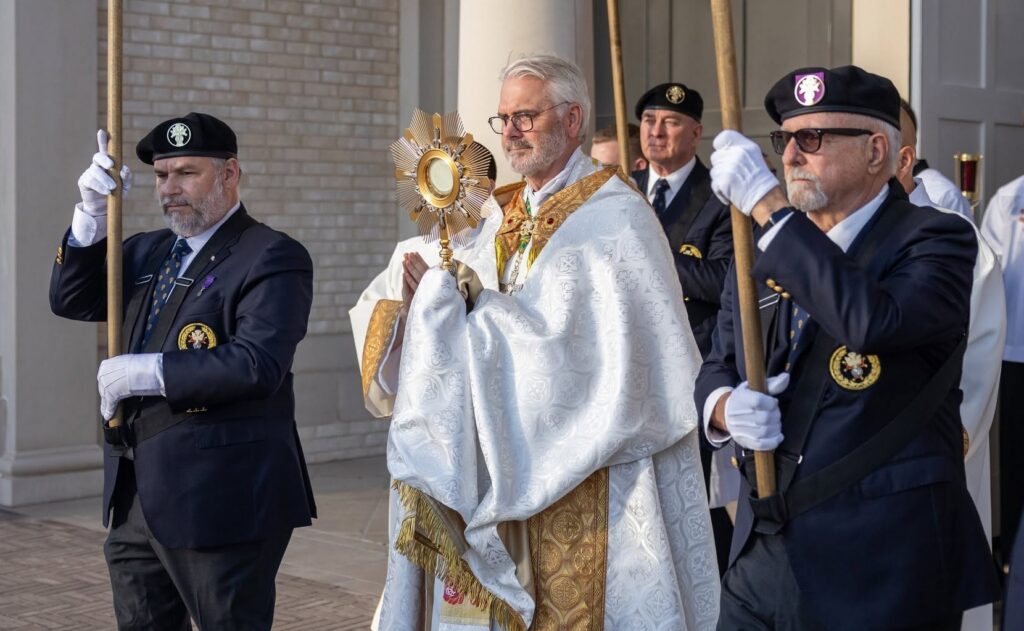
Archbishop Charles Salatka Assembly 2044 is comprised of the 4th Degree members of Yukon Council 6478 and Mustang Council 8633. The Fourth Degree is led by the Faithful Navigator, and is the ceremonial representation of the Order.
Members of Assembly 2044 appear in honor guards as requested by the parish priest, Archbishop or for memorial services for deceased brother Knights.
Members also serve as color guard or color corps proudly presenting the US, State, Papal and KofC flags at formal events.
These events are led by the Color Corps Commander.
Who Are the Fourth Degree Knights?
The Patriotic Degree reminds us of our duty to God and country.
History of the Fourth Degree
From the earliest days of the Order, members wanted to create a form of hierarchy and recognition for senior members (Egan & Kennedy, 117) This issue was discussed at the National Meeting of 1899 (Kauffman 1982, pp. 137–139). As early as 1886, Supreme Knight James T. Mullen had proposed a patriotic degree with its own symbolic dress (Kauffman 2001, p. 15). From these discussions, the Fourth Degree was created, adding to the three previous degrees of charity, unity, and fraternity (Kauffman 2001).
About 1,400 members attended the first exemplification of the Fourth Degree at the Lenox Lyceum in New York on February 22, 1900 (Egan & Kennedy) (Kauffman, 1982). The event was infused with Catholic and patriotic symbols, imagery that "celebrated American Catholic heritage.” The two knights leading the ceremony, for example, were the Expositor of the Constitution and the Defender of the Faith (Kauffman 2001, p. 2). The ritual soon spread to other cities. The new Fourth Degree members returned to their councils, forming assemblies composed of members from several councils. Those assemblies chose the new members (Egan & Kennedy, p. 118) (Borowski).
In 1903, the Board of Directors officially approved a new degree exemplifying patriotism Order-wide, using the New York City model (Egan & Kennedy, p. 118). The Order had a "desire to receive within its ranks only the best" and intended the men should be practicing Catholics. As one measure, each candidate was required to submit a certificate from his parish priest attesting that he had received Holy Communion within the past two weeks (Egan & Kennedy, p. 119).
Fourth degree members belong to one of 3,109 assemblies, including 75 created in 2012 (Annual Report of the Supreme Knight). The first assembly in Europe was established in 2012, and in 2013 a new assembly for Boston-area college councils was created at Harvard University ("Congratulations to Our Newest Sir Knights!").] As of 2013, there were 335,132 Fourth Degree members, including 15,709 who joined the ranks of the Patriotic Degree the year before.
In its early days, it worked to counter the bias that good Catholics could not be good Americans (Kauffman 2001, p. 15). The early Fourth Degree ceremony stressed the contributions Catholics from many countries had made to the United States (Kauffman 1982, p. 121) and had Catholic citizenship as its theme (Kauffman 1982, p. 139).
Color Corps (Color Guard / Honor Guard)
Assemblies may form color corps, which are often the most visible arm of the Knights. The color corps have two main functions; flag ceremonies, and special ceremonies or funerals. They often attend important civic and church events (Borowski). The color guard posts the flags at the beginning of the state convention or other event. An honor guard will stand guard at the casket of a fallen brother knight or priest.
The first Fourth Degree uniform, adopted in 1900, consisted of white ties, top hats and tails (Gutiérrez) (Conlon). In 1940, the uniform changed to a plumed chapeau, a tuxedo, a cape and a ceremonial sword (Conlon). With the 1940 uniform, the Supreme Master wore a dark blue cape and chapeau. A vice supreme master wore a light blue cape and chapeau. A master wore a gold cape and chapeau. A district marshal wore a green cape and chapeau. A faithful navigator wore a white cape and chapeau. A color corps commander wore a purple cape and chapeau, and the remaining members wore red capes and white chapeaus (Borowski). This regalia were passed down through generations of Knights to their sons and grandsons.
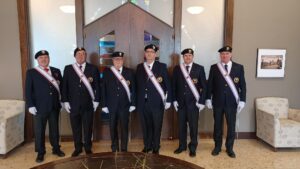
In 2017, in an attempt to attract younger members, the uniform changed again to consist of a blue blazer and dark gray slacks. The uniform is finished off with an official Knights of Columbus tie, and a black beret with the fourth-degree logo in a gold metal emblem. Colored flashings are placed behind the emblem to identify the Supreme Master, Vice Supreme Master, Master, District Marshal, Faithful Navigator and Color Corps Commander. The other members also wear a white shirt and dark gray slacks (Gutiérrez) (Conlon) (Hopfensperger). The ceremonial sword is still a prominent piece of the uniform.
Sources
- Egan, Maurice Francis; Kennedy, John James Bright (1920). The Knights of Columbus in Peace and War. Vol. 1. ISBN978-1-142-78398-3.
- Kauffman, Christopher J. (1982). Faith and Fraternalism: The History of the Knights of Columbus, 1882–1982. Harper and Row. ISBN978-0-06-014940-6.
- Kauffman, Christopher J. (2001). Patriotism and Fraternalism in the Knights of Columbus. New York: Crossroad Publishing Company. ISBN978-0-8245-1885-1.
- Egan, Maurice Francis; Kennedy, John James Bright (1920). The Knights of Columbus in Peace and War. Vol. 1. ISBN978-1-142-78398-3.
- Borowski, Dave (November 5, 2014). "Mysteries of the regalia revealed". Catholic Herald. Retrieved December 4,2019.
- "Annual Report of the Supreme Knight"(PDF). Knights of Columbus. August 6, 2013. Retrieved October 16, 2013.
- "Congratulations to Our Newest Sir Knights!". Harvard Council No. 14188. Retrieved November 13,2013.
- Kauffman, Christopher J. (1982). Faith and Fraternalism: The History of the Knights of Columbus, 1882–1982. Harper and Row. ISBN978-0-06-014940-6.
- Gutiérrez, Tony (August 2, 2017). "Knights of Columbus Change Fourth Degree Uniforms". The Catholic Sun. Phoenix. Retrieved March 29,2018.
- Conlon, Mickey (May 29, 2019). "The Knights of Columbus are getting a new uniform after 79 years". America. Retrieved December 4,2019.
- Hopfensperger, Jean (August 9, 2019). "Knights of Columbus work to refresh image, attract younger members". Star Tribune. Retrieved December 4,2019.